إذا طُلب منك “بحث عن الذكاء الاصطناعي بالانجليزي” فغالبًا أنت تريد شيئًا عمليًا: نص قصير مرتب تستطيع نسخه وتعديله بسرعة، بدون تعقيد أكاديمي أو مصطلحات ثقيلة.
في هذا المقال جهّزنا لك بالضبط ما تحتاجه كطالب:
- نسخة مختصرة جاهزة بالإنجليزية (Short Research) بثلاث صيغ: قصيرة جدًا، قياسية، ومدرسية سهلة.
- قاموس أهم المصطلحات (Glossary) مع معنى مبسّط واستخدام داخل جملة، حتى تكتب بثقة وتبدو لغتك “أكاديمية بسلاسة”.
- قالب هيكل بحث (Template) يساعدك ترتّب المقدمة، الفكرة، الأمثلة، والخاتمة.
- وفي النهاية: جُمل جاهزة للربط بين الأفكار، أخطاء شائعة تتجنبها، وأسئلة سريعة (FAQ) لو احتجت توضيح إضافي.
النسخة المختصرة الجاهزة بالإنجليزية (Ready-to-copy)
1) نسخة قصيرة جداً (Short Version)
Artificial Intelligence (AI) is a technology that enables computers to perform tasks that usually require human intelligence, such as learning from data, recognising patterns, and making decisions. In simple terms, AI systems are trained on large datasets so they can predict results or recommend actions based on what they have learned. Today, AI is widely used in daily life, for example in voice assistants, recommendation systems on streaming platforms, and navigation apps that suggest the fastest routes. AI can improve efficiency and accuracy in many fields, but it also raises important concerns such as data privacy and fairness. In short, AI is a powerful tool that can support people and society when used responsibly.
2) نسخة مختصرة قياسية (Standard Short Research)
Artificial Intelligence (AI) refers to computer systems that can perform tasks that normally require human intelligence, such as learning, problem solving, and decision making. Unlike traditional programs that follow fixed instructions, many AI systems learn from data to identify patterns and make predictions. This ability makes AI useful in situations where we need speed, accuracy, and smart automation.
Today, AI is used in many areas of everyday life and work. For example, it helps doctors analyse medical images, supports online customer service through chatbots, and improves education by personalising learning based on each student’s needs. AI also powers recommendation systems on platforms like YouTube and Netflix, and it can assist cities with traffic management and public services through smart solutions.
However, AI also comes with challenges. Some systems may produce biased results if the data used for training is unfair, and privacy can be at risk when personal data is collected or analysed without clear consent. In conclusion, AI can bring major benefits when used responsibly, with careful attention to ethics, transparency, and human oversight.
3) نسخة مختصرة “مدرسية” (School-Friendly)
Artificial Intelligence (AI) is a technology that helps computers perform tasks that require human intelligence. It can learn from data by training on many examples, so it becomes better at recognising patterns and making useful decisions. For example, when you use a voice assistant, or when an app suggests a video you may like, AI is working in the background.
AI is used in many important fields today. In education, it can support students by suggesting lessons that match their level. In healthcare, it can help doctors detect problems in medical scans. AI can also help businesses save time by automating repetitive tasks.
Even though AI is useful, we should use it carefully. Some AI systems can be unfair if they learn from biased data, and people’s privacy can be affected if personal information is used without permission. In conclusion, AI is a powerful tool, and it becomes more helpful when we use it responsibly and ethically.
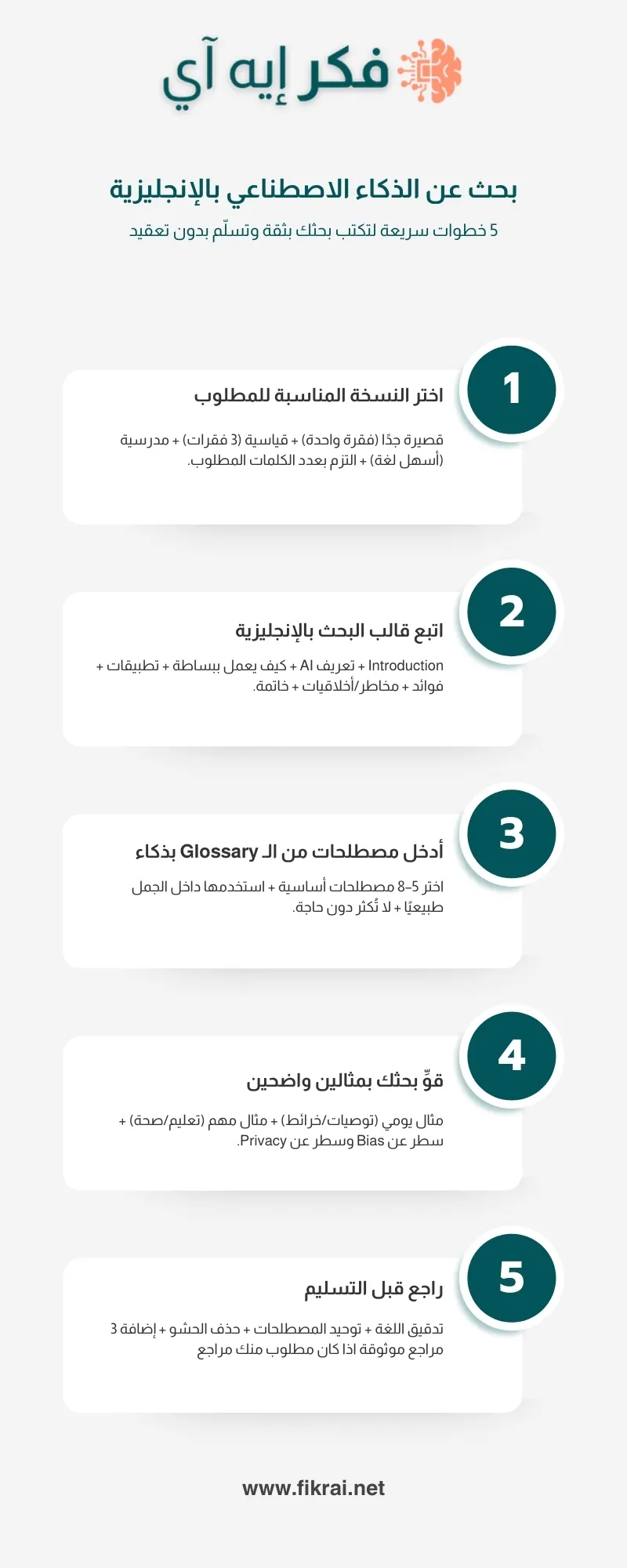
هيكل البحث بالإنجليزية (Template Structure)
1) Introduction
- Hook (جملة افتتاحية قوية): ابدأ بجملة تشرح لماذا AI مهم اليوم.
- Purpose (هدف البحث): وضّح أن البحث يعرّف AI ويعرض استخداماته وفوائده وتحدياته.
- Roadmap (ماذا سيغطي): جملة قصيرة تقول: سنشرح التعريف، كيف يعمل ببساطة، التطبيقات، الفوائد، ثم المخاطر والخاتمة.
Example (ready-to-use):
Today, Artificial Intelligence (AI) has become one of the most important technologies in modern life. This research explains what AI is, how it works in simple terms, where it is used, and what benefits and risks it can bring. By the end, the reader will understand why AI is powerful and why it should be used responsibly.
2) What is Artificial Intelligence?
- تعريف بسيط وواضح (بدون تعقيد).
- توضيح الفرق بين AI والبرامج التقليدية (AI يتعلم من البيانات بدل أوامر ثابتة).
- مثال سريع يثبت الفكرة (recommendations / spam filter / face recognition).
Example (ready-to-use):
Artificial Intelligence (AI) is the ability of a computer system to perform tasks that normally require human intelligence, such as learning, recognising patterns, and making decisions. Traditional programs follow fixed instructions, but many AI systems learn from data and improve their performance over time. For example, an email spam filter uses AI to learn which messages are spam by analysing many examples.
3) How AI Works (in simple words)
- Data (البيانات): AI يحتاج أمثلة كثيرة ليتعلم.
- Algorithm/Model (الخوارزمية/النموذج): “طريقة التعلم” التي تبني نموذج يتوقع أو يصنّف.
- Training vs Testing (التدريب والاختبار): يتعلم أولًا ثم نتحقق من دقته.
- Output (النتيجة): prediction / recommendation / classification.
Example (ready-to-use):
AI works by learning from data. First, the system is trained on many examples (a dataset). Then, an algorithm builds a model that can recognise patterns in the data. After training, the model is tested to check how accurate it is. Finally, the AI system produces an output, such as a prediction, a recommendation, or a classification. For example, an AI photo app can learn from many images and then recognise whether a picture contains a cat or a dog.
4) Real-Life Applications
- اذكر 3–5 مجالات مع أمثلة قصيرة وواضحة.
- اجعل الأمثلة “قابلة للتخيل” للقارئ: تعليم، صحة، أعمال، مدن ذكية، ترفيه.
Example (ready-to-use):
AI is used in many real-life applications. In education, it can personalise learning by suggesting exercises that match a student’s level. In healthcare, AI can help doctors analyse medical images and detect signs of disease earlier. In business, it supports customer service through chatbots and helps companies predict demand. AI is also used in smart cities to improve traffic management and public services. In entertainment, recommendation systems suggest movies, music, or videos based on a user’s preferences.
5) Benefits of AI
- ركّز على فوائد مفهومة: السرعة، الدقة، الأتمتة، تقليل الأخطاء، دعم القرار.
- اربط كل فائدة بمثال صغير (ولو بكلمتين).
Example (ready-to-use):
AI offers many benefits. It can process large amounts of information much faster than humans and often with high accuracy. It also helps automate repetitive tasks, which saves time and reduces human error. In addition, AI can support better decision making by finding patterns that people may miss, such as predicting machine failures or identifying trends in customer behaviour. Overall, AI improves efficiency, productivity, and the quality of services in many fields.
6) Risks and Ethical Concerns
- ركّز على 4 محاور بسيطة: Bias (تحيز)، Privacy (خصوصية)، Transparency (شفافية)، Jobs (الوظائف).
- اختم بجملة: “الحل هو الاستخدام المسؤول والرقابة البشرية”.
Example (ready-to-use):
Despite its advantages, AI also has risks and ethical concerns. Some AI systems can produce biased results if the training data is unfair or incomplete. Privacy can also be threatened when personal data is collected, stored, or analysed without clear consent. Another challenge is transparency, because some AI models work like a “black box,” making it difficult to understand how they reach decisions. In addition, automation may affect certain jobs by replacing repetitive work. For these reasons, AI should be developed and used responsibly, with clear rules, transparency, and human oversight.
7) Conclusion
- سطر يلخّص ما هو AI.
- سطر يلخّص أهم الاستخدامات/الفوائد.
- سطر أخير متوازن: فوائد كبيرة لكن نحتاج مسؤولية وأخلاق.
Example (ready-to-use):
In conclusion, Artificial Intelligence (AI) is a powerful technology that enables computers to learn from data and perform intelligent tasks. It is widely used in education, healthcare, business, and many daily applications, offering speed, efficiency, and better decision support. However, AI also brings challenges such as bias, privacy risks, and ethical concerns. Therefore, the best approach is to use AI responsibly, with transparency and human oversight to ensure it benefits people and society.
Glossary: أهم مصطلحات الذكاء الاصطناعي (Glossary)
مصطلحات أساسية (Must-know)
| Term | المعنى بالعربية | تعريف مبسّط | Example sentence |
| Artificial Intelligence (AI) | الذكاء الاصطناعي | أنظمة تجعل الكمبيوتر ينفّذ مهام “ذكية” مثل التعرّف واتخاذ القرار | AI is used in many daily applications. |
| Machine Learning (ML) | تعلّم الآلة | فرع من AI يجعل النظام يتعلم من البيانات بدل قواعد ثابتة | ML learns patterns from data. |
| Deep Learning (DL) | التعلّم العميق | نوع من ML يعتمد على شبكات عصبية متعددة الطبقات | DL is often used in image recognition. |
| Neural Network | شبكة عصبية | نموذج مستوحى من الدماغ يلتقط الأنماط من البيانات | A neural network can classify images. |
| Dataset | مجموعة بيانات | البيانات التي ندرّب ونختبر عليها النموذج | The dataset contains many examples. |
| Training | التدريب | مرحلة تعلّم النموذج من البيانات | The model improves during training. |
| Testing | الاختبار | مرحلة قياس دقة النموذج بعد التدريب | Testing shows how accurate the model is. |
| Prediction | التنبؤ | نتيجة يتوقعها النموذج (مثل: سعر/احتمال/تصنيف) | The system makes a prediction from new data. |
| Bias | التحيّز | نتائج غير عادلة بسبب بيانات تدريب غير متوازنة | Bias can lead to unfair decisions. |
| Privacy | الخصوصية | حماية بيانات الأشخاص من الاستخدام غير المصرّح | Privacy is important when using user data. |
مصطلحات إضافية (Bonus Terms)
| Term | المعنى بالعربية | تعريف مبسّط | Example sentence |
| Natural Language Processing (NLP) | معالجة اللغة الطبيعية | جعل الكمبيوتر يفهم النصوص والكلام | NLP helps computers understand text. |
| Computer Vision | الرؤية الحاسوبية | فهم الصور والفيديو | Computer vision can detect objects. |
| Generative AI | الذكاء الاصطناعي التوليدي | إنشاء محتوى جديد مثل نصوص أو صور | Generative AI can create new images. |
| Large Language Models (LLMs) | نماذج اللغة الكبيرة | نماذج تفهم وتولّد نصوصًا بناءً على بيانات ضخمة | LLMs can generate human-like text. |
| Reinforcement Learning | التعلّم بالتعزيز | تعلّم عبر المكافأة والعقوبة | RL improves by trial and error. |
| Algorithm | خوارزمية | خطوات/طريقة يتبعها النظام للتعلّم أو الحل | The algorithm updates the model. |
جُمل إنجليزية جاهزة تساعدك تكتب بحث بشكل “أكاديمي بسيط”
1) جُمل افتتاحية (Openers)
- Today, Artificial Intelligence (AI) is one of the most influential technologies in the world.
- In recent years, AI has become a key part of modern life and business.
- This research discusses AI, its applications, and its main benefits and challenges.
2) جُمل لشرح الأفكار (Explaining Ideas)
- AI systems learn from data to recognise patterns and make decisions.
- Unlike traditional software, AI can improve its performance over time.
- In simple terms, AI aims to solve problems faster and more accurately.
3) جُمل للانتقال بين الفقرات (Linking Words)
- Moreover, … / In addition, …
- However, … / On the other hand, …
- As a result, … / Therefore, …
- For example, … / For instance, …
4) جُمل للخاتمة (Conclusions)
- In conclusion, AI can be highly beneficial when used responsibly.
- Overall, AI offers great opportunities, but it also requires ethical guidelines.
- To sum up, AI should support people, not replace human responsibility.
أخطاء شائعة تخرب البحث (وكيف تتجنبها)
- كتابة تعريف عام جدًا بدون مثال
- الحل: أضف مثالًا واحدًا واضحًا مثل: spam filter أو recommendations.
- اعتبار الذكاء الاصطناعي = روبوتات فقط
- الحل: وضّح أن AI موجود في التطبيقات والخدمات الرقمية وليس فقط الروبوتات.
- نسخ ترجمة حرفية (ركاكة لغوية)
- الحل: استخدم النسخ الجاهزة هنا ثم عدّلها بأسلوبك بدل ترجمة سطر بسطر.
- نسيان جزء “المخاطر والأخلاق”
- الحل: اذكر سطرين عن privacy و bias حتى يبدو بحثك متوازنًا.
- استخدام مصطلحات كثيرة بدون شرح
- الحل: اختر 5–8 مصطلحات فقط من الـ Glossary واستخدمها بشكل طبيعي داخل البحث.
مراجع مبسطة (اختيارية حسب متطلبات مدرستك)
إذا طُلب منك “References” أو “Sources”، يكفي أن تضع 3–5 مراجع موثوقة مثل الآتي (اختر منها ما يناسبك):
- Stanford University – AI Index Report
- MIT News – Artificial Intelligence
- NIST – AI Risk Management Framework (AI RMF)
- UNESCO – Ethics of Artificial Intelligence
- OECD – AI Principles
ملاحظة صغيرة: إذا لم يُطلب منك مراجع صراحة، يمكنك تجاوز هذا القسم تمامًا، خصوصًا في النسخ “القصيرة”.
للتوسع (لمن يريد نسخة أطول)
إذا أردت نسخة عربية موسّعة تساعدك تفهم الموضوع أكثر قبل كتابة بحثك بالإنجليزية، يمكنك الرجوع إلى مقالنا الأساسي هنا:
بحث عن الذكاء الاصطناعي
FAQ (أسئلة شائعة)
أي نسخة أختار من النسخ الثلاث؟
إذا طُلب منك فقرة واحدة اختر القصيرة جدًا، وإذا طُلب بحث مختصر من 3 فقرات اختر القياسية، وإذا أردتها أسهل لغة اختر المدرسية.
كم عدد الكلمات المناسب؟
عادةً: قصيرة جدًا 90–130، قياسية 160–220، مدرسية 180–260 (واتبع رقم المعلّم إن وُجد).
ما الفرق بين AI و ML و DL؟
AI مفهوم عام، ML يتعلّم من البيانات، DL نوع من ML يعتمد الشبكات العصبية.
كيف أجعل البحث قويًا وليس عامًا؟
اكتب مثالين واضحين فقط: مثال يومي (توصيات/خرائط) ومثال من مجال مهم (تعليم/صحة).
ما أقل نقطة أخلاقية لازم أذكرها؟
اذكر باختصار التحيّز (Bias) والخصوصية (Privacy)، ثم جملة عن الاستخدام المسؤول والرقابة البشرية.
أصبح لديك الآن ثلاث نسخ جاهزة لبحث عن الذكاء الاصطناعي باللغة الإنجليزية، ومعها قالب واضح لتنظيم الأفكار، وقاموس مصطلحات يساعدك على استخدام المفاهيم بثقة. اختر النسخة التي تناسب المطلوب، ثم عدّلها بتفاصيل بسيطة مثل اسمك، مستوى دراستك، ومثال واحد قريب من حياتك اليومية. وإذا احتجت إلى توسيع البحث، فاستخدم القالب وأضف فقرة قصيرة عن التطبيقات أو فقرة موجزة عن الجوانب الأخلاقية.
المراجع التي استخدمت في كتابة المقال
- Stanford University – AI Index Report
- NIST – AI Risk Management Framework (AI RMF)
- UNESCO – Recommendation on the Ethics of Artificial Intelligence
- OECD – Principles on Artificial Intelligence
- MIT News – Artificial Intelligence
- Encyclopaedia Britannica – Artificial Intelligence
- IBM – What is AI bias?

مهندسة برمجيات مبتدئة تعمل في شركة ناشئة متخصصة بالذكاء الاصطناعي الطبي. شغوفة بمجال الصحة الرقمية وكيف تساعد الخوارزميات في تشخيص الأمراض.